

William Tester's DARLING
Cow person

This is First Breath—one paragraph, up close, every Friday*
*except! I am working on a new project I’m so excited about (and I hope to share it with you sooner than later), so I’m planning to skip some Fridays here and there until the fall. I’ve turned off paid subs for now until I’m fully back here (and if any new paid subs want a refund I am happy to give you one, just reach out).
I’m KKP. Please consider subscribing if you’re a writer or reader interested in sentence-level craft. Share if you know someone else who might be into it.
The Book
Just like actual flesh-and-blood children, readers have strong opinions and seem fairly divided on child narrators. One of my best friends, who was sort of a notorious kid-hater before I had my sons, says he’d like children more if adults didn’t talk about them so much.
One reason people have issues with child narrators is that we all know examples of those that aren’t done well—in literature, sure, but maybe especially in TV and film. When done poorly, the young voice can be cloying or too precocious. It can serve as a hackneyed vehicle for adult observation, which is a particular peeve of mine: little kids delivering profound and sweeping sentiments about the human condition or the political climate. Mommy, why does everybody hate each other on the news? Child narrators can be too smart or too stupid or just plain annoying. The pitfalls are many, and every one of them chips away at the authenticity of the voice.
Still, I’d argue that when it’s done well, it’s worth the risk, because a convincing child narrator moves me in ways an adult narrator can’t. I have a talk called “Five Kinds of Wildness” about child and teenage narrators in literary fiction, and it argues that the traits we tolerate in children because we have to (limitless imagination, frank insight, outsized authority, bottomless need, shamelessness) are in fact the traits a writer needs most. In that talk I look at work from Vauhini Vara, Miriam Toews, Mark Richard, Justin Torres, T Kira Māhealani Madden, Sandra Cisneros. But the trickiest one to talk about is William Tester.
Darling came out from Knopf in 1991. Tester was raised on a cattle ranch in Florida, and went to Columbia. Amy Hempel picked his story collection Head for the Mary McCarthy Prize. Gordon Lish acquired and edited Darling, and Tester has said that between 1988 and 1990, Lish guided him in weeding through hundreds of pages of iambs and rant to get to the slim version of the novel as we know it. From everything I’ve read, Tester says the experience was a positive one, saying, years later, in a comment on a blog post cataloging Lish’s Knopf list, “He had a brilliant hand. Loved the man.” (Somebody can correct me if I’m wrong, but I’m not going to read too much into the past tense there). Diane Williams is one of five people (along with Peter Christopher, somebody else I want to write about soon) that Tester thanks in his acknowledgments.
The book is centered on two brothers, Jeab and Bubba (I know!). They are former Florida farm boys who have reconnected after Jeab’s shore leave in New York, and are living together in Bubba’s apartment. Bubba is the younger brother, and he’s our narrator. Some of the things Bubba and Jeab like doing are sitting up all night at a kitchen table with beer and a loaded pistol, working through their grievances. The chief grievance is Darling. Darling is a cow. Both brothers loved her, and each is certain she loved him best. Like, for real—this isn’t a metaphor. I never know when is the right time to drop the bestiality bit but, I don’t know, there you go. I love this book so much that it feels worth it to keep mentioning it in talks and showing text from it, but even I’m too scared to actually assign it to students. Tester’s sentences are so beautiful that (I hope!) all the awfulness of the premise is worth it. “Oh, I know you,” a student (but not mine) at Pacific once said to me. “You’re the cow person.”
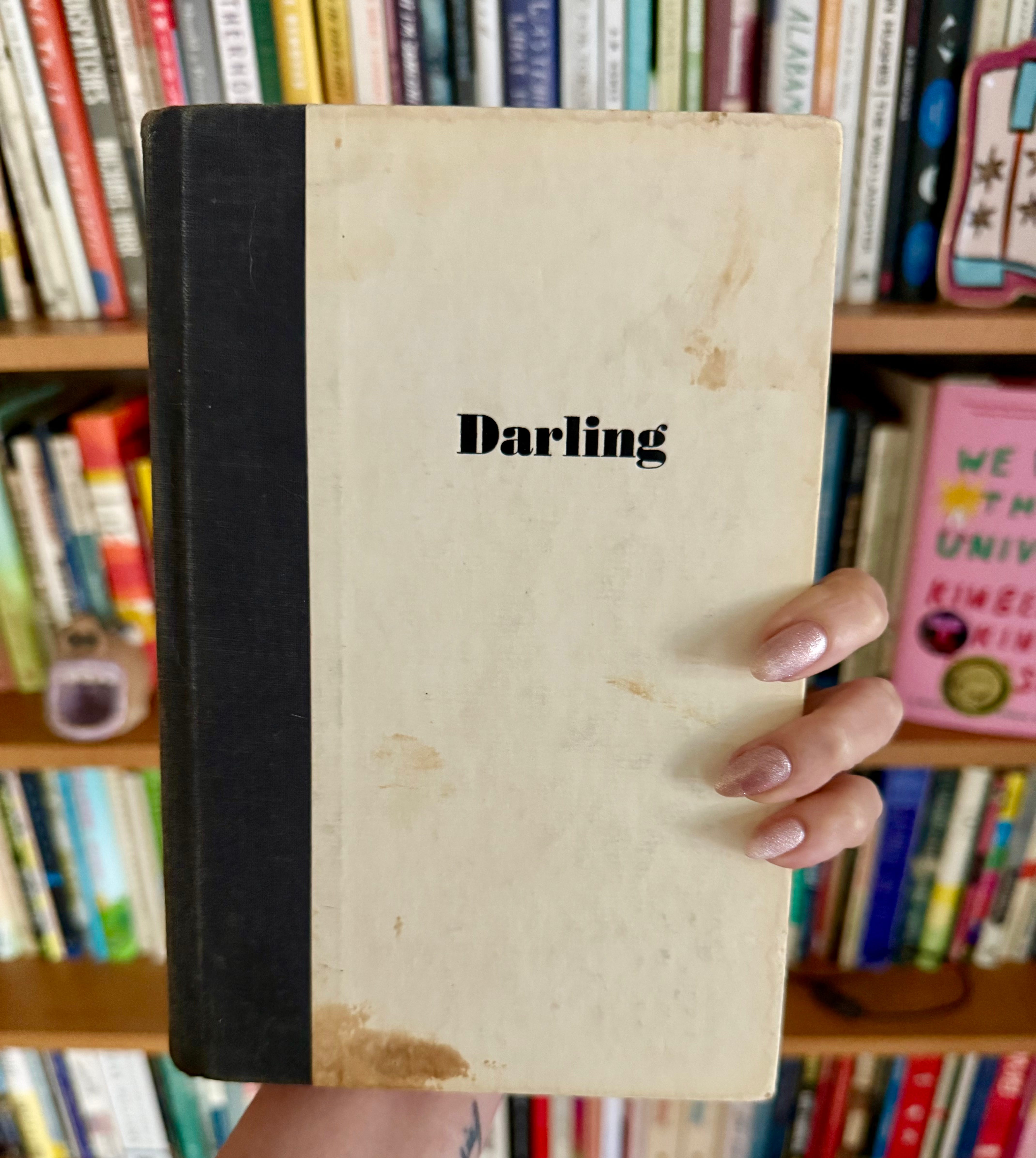
You might or might not be surprised to know the book was pretty well received in 1991. Library Journal called it “a fine first novel filled with sensual imagery and emotional turmoil,” and predicted readers would want more from Tester. Publishers Weekly called it audacious, noted it was a psychological tour of the narrator’s kinky past, and said that by the end, “the reader is ready for just about anything” (lol). Kirkus was mad about it. They pointed out that when these brothers aren’t reminiscing about their shared bovine love they are reminiscing about their shared love for their “girl cousin.” This isn’t a lie, though I sometimes forget about cousin Kay because she’s so eclipsed by the cow of it all. They also called the novel “thinly storied…encrustedly lyrical.” Again—not wrong, but those last two are selling points for certain readers (me).
The contemporary reception has gone about how you might expect. There are only a few reader reviews online, ranging from people wondering if English is Tester’s first language, to one reader who wished the narrator had figured out he was in love with his brother instead of “making it that poor cow’s problem,” to a disappointed reader who just wistfully said, “I had high hopes—this is about a farm boy in love with his cow.”
The book is out of print (criminally, I would argue, but also I get it), and it has one of the most authentic child narrators I have ever read—but the child isn’t who speaks first. I’m going to give you the first, first paragraph (at the table with Bubba and Jeab and the loaded gun) and then I’m going to give you the first paragraph of the second chapter, because that’s where the kid voice kicks in, and I think you need both to really see what Tester is doing. The rest of the book moves between these planes.
The Paragraph
How can I remember her all at once when what I want is to forget? My sin, her hide against my body—God, our lives.
What’s Happening
How can I remember her all at once when what I want is to forget?
The opening section is called “The Killers,” and you can hear the torment in it. This first part sounds like any painful memory, and we will (wrongly) assume we’re talking about a human woman for as long as Tester lets us. We assume (again wrongly, but also, kind of rightly?) that this is the beginning of a story about grief for a lost love. By the next sentence we will start to piece the unsettling puzzle together (Her whattt? Her hide?). Soon we will know (all too well) that the antecedent for this “her” is Darling, the family dairy cow. I always tell students that we choose our readers with every aesthetic decision we make, and not every book is for every person. This book may in fact only be for like, nine people, of whom I am one. I still think it’s best to go hard right out of the gate so you can save yourself and your reader a lot of time. You will never make a reader love a character by tricking them, just let them be who they are. Tester only keeps the pronoun a mystery for this single sentence, and then we get the whole picture.
My sin, her hide against my body—God, our lives.
This first half of the sentence runs together in apposition. My sin, and then her hide against my body with no verb to separate them. The two nouns press against each other the way the bodies did. The way it’s written here, the sin is the hide. The second half is so tortured, either a prayer or a curse, and I don’t think Tester wants us to know which one. I leads to my leads to our. We don’t know who all is included in the damage beyond the “I” and the “her” but we can feel the scope widening.
The big question the book circles is how and what Bubba remembers, and how this memory (or the avoidance of it) affects his adult life. You might expect Bubba to have nothing but retrospective disgust for his choices in childhood and adolescence, but this is not how Darling unfolds. This really is (I’m sorry!) a love story.
The Other Paragraph
See my brother and my mother and me in the light in our backyard, out by the barn and the silver silo rocketed up above the barn, here on the farm of what is all there is in the world in my mind? All there is is towered arching toward our barn, it seems to me, small on the grass below the boards of the bone white fence in our backyard. ‘See the cowy-cow?’ my mother leans and says to me; she tugs me stood-up to her skirt front. ‘Come, and see the pretty cow?’
This section is called “Child.” The register has changed completely, and where the adult Bubba in “The Killers” was careful and halting and full of angst, the child’s voice shows us the “all at once” fearlessly. All at once becomes “all there is,” and he is breathless to tell us about it. He can handle what adult Bubba (big Bubba?) can’t.
Both pages also open on a question. The man asks how to remember, and the boy asks us to look. See—it’s a command, like, this is how, you just look! It’s addressed to us, and it’s still phrased as a question. Do we see this childhood, this whole life? And then his mother says it back to him. “See the cowy-cow?” He’s repeating her command to us, and we know she’s the woman who taught him to look. What she wants him to see is Darling. Adult Bubba showed her as a source of shame, but this time it’s introduced to the child by his mother, in baby talk, as something pretty. “Come, and see the pretty cow?” In the first section we only got her in pieces, “her hide,” but now she gets a second, sweeter introduction.
“The farm of what is all there is in the world in my mind” doesn’t resolve, it just keeps complicating with prepositional phrases. The child is saying that this farm is the totality. His world ends at the fence, but even so, he doesn’t have the grammar to contain the enormity of it. “All there is is,” is a doubled verb that reads like a typo at first. Any sane editor would kill that (but we know the one guy who didn’t).
He is “small on the grass” looking up, and we are beautifully locked in this small perspective. And then comes my favorite part: “She tugs me stood-up.” A past participle is jammed in where a preposition would normally be, so the standing happens to him inside the verb. He doesn’t stand but is stood up, by her. Something about this gesture is unbelievably moving to me. The memory of being small, pulled up by your mother. She arranges him against her skirt front, a place on a person that I never think about from my adult height, but now I can see it perfectly from small-on-the-grass height.
When I was maybe twenty-one, I took a job as a teacher’s assistant in a preschool called Noah’s Ark, helping out with a dozen three-year-olds. All the classes were named after animals and mine was called the Lambs. It was an exhausting job, but every day I ended up with a notebook full of genius observations and truly psychedelic questions from my tiny students. “Nine is the P of numbers,” an excited lamb once shouted during circle time. “How did tongues become in our mouths?” a totally different lamb wanted to know. “She tugs me stood-up” is a child reaching for a construction that doesn’t exist in English. The grammar isn’t correct, but sometimes a lamb needs to repurpose a verb to find out what’s going on with our tongues, and young Bubba needed a verb for being put upright by his mother. They make it work.
Acoustics
First, the grown-up Bubba voice. How can I remember her all at once when what I want is to forget? The w’s carry that opening sentence, when, what, want, which is the right sound for a man asking so many questions about his past. The first sentence is open with these semi-vowels, but in the second one the long i chain runs my, hide, my, lives, and the stresses cluster. The d’s percussively pile up in hide, body, God.
The child’s page works on the same principle but in breathless running sentences. (I’ve struggled to read it aloud many times in a classroom, and it’s not easy!) All there is is towered arching toward our barn—beat, beat, beat, and the b’s keep building. Backyard, barn, barn, barn, below, boards, bone, backyard. The barn appears three times in two sentences, which a copy editor would flag, but which is, of course, exactly how a child speaks. Young Bubba’s stops are everywhere too, but they’ve been strung out instead of packed in. Backyard, rocketed, world, mind, towered, toward, boards, backyard again, stood—plus five separate ands, my brother and my mother and me, the barn and the silver silo, leans and says, Come, and see. It’s the breathless litany of an excited kid.
The hiss of silver silo, and then cowy-cow, which is the mother’s baby talk and the paragraph’s tonal center. Reduplication, the ow held twice, the hard c handing off to the hard c of Come. A hard c is a stop as well, released into that rounded glide, twice, so it never quite finishes becoming a word.
Why I Love It
These two beginnings are the collision of man and boy. Adult Bubba is full of grief and shame, but to little Bubba the silo is a rocket ship, and the yard is the whole world. The farm is lit up by his imagination, shimmery and remembered. That’s what a child’s attention does to a thing. Even simple things fascinate them. You and I don’t twist doorknobs over and over or watch the washing machine go around, but a kid who hasn’t yet fully grasped the idea of rotation will marvel at those things. Little Bubba is looking at Darling with this same curiosity and care.
Later in the novel, child Bubba describes his mother’s body as being like ice cream, smooth and cool and amazing. Bubba isn’t being creepy (at least not yet). He only knows and craves the sensation of being close to another person. This devotion to the senses is particularly strong in children—newly in their bodies, learning what separates them from everything else, working out their very first (and most painful) biological lesson: we are not our mothers.
So fine, you don’t have to write about a guy who has a torrid love affair with a cow, but getting back to a child’s level of base exploration can be a tremendously good thing for a writer. I used to call the loose skin on my grandmother’s arms her “baggies,” and I’d fondle them while we watched TV together. That’s the kind of easy intimacy children have, a sensuousness completely unbound by social norms. You don’t have to go to cow-loving extremes to tap into this place.
Another little takeaway: whenever I worry that I’m writing something too weird or off-putting I just think about Tester having to explain to people what his debut novel is about for the rest of his life. If he can walk around in the world after that (as a guy who grew up on a cattle farm IRL!) then I think the rest of us can calm down.
Adult Bubba asks how to remember Darling all at once, and he can’t do it, because he knows too much now about the taboo of what he’s done. Putting the story into words is unbearable (there is no way he can justify his actions or reconcile them with the adult he is, knowing what he knows now), so Bubba dispenses with the present and moves into the syntax of a child. He brings us into the body of a boy standing on the grass with the whole world ending at the fence line, turned by the shoulders toward the thing he’s not supposed to love.
Okay, see you in two-ish weeks and thank you, as ever, for reading!
Some news:
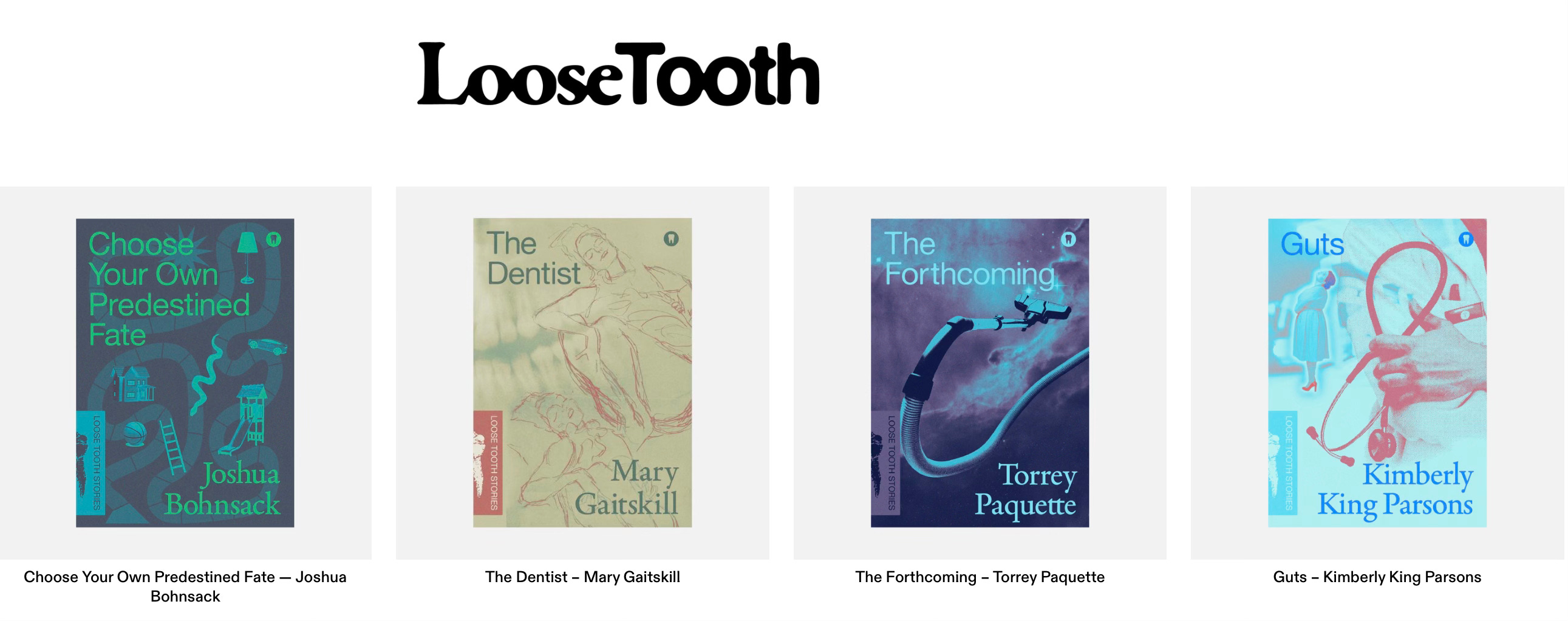
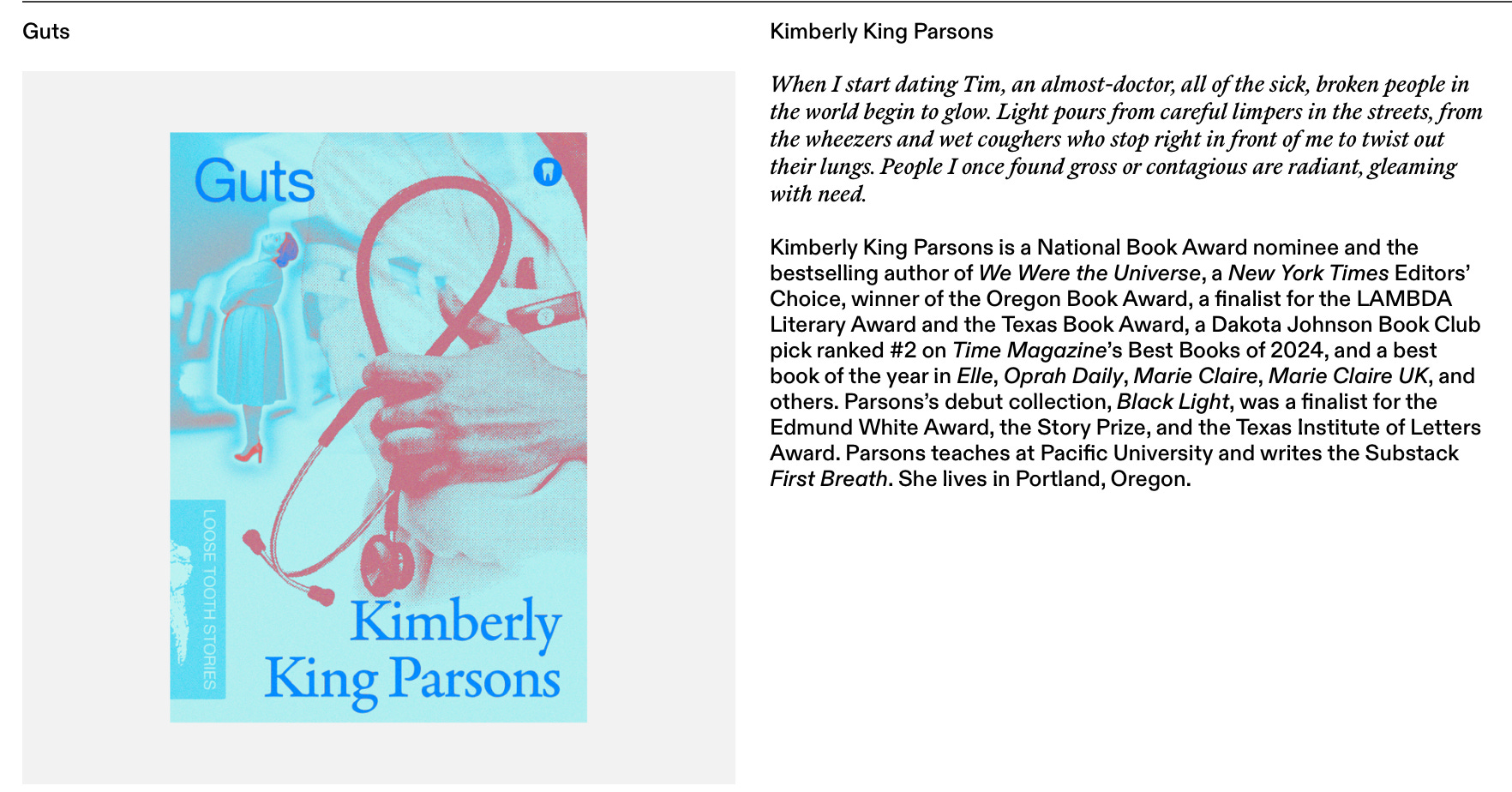
I’m so excited to have a story in the Loose Tooth series alongside Mary Gaitskill, Joshua Bohnsack, and Torrey Paquette. You can preorder the bundle now.
These little standalone books are so cool. From their website: “Loose Tooth is an independent publishing project and small press based in New York City that publishes short fiction as single-story editions, small enough to carry in your pocket or read in a single sitting. We’re dedicated to publishing good stories by both emerging and established contemporary writers. Our books are printed in small batches and shipped by hand.”
Chelsea Bieker and I launched The Fountain’s Writing Reset and it starts on Monday! We have a guided curriculum, a beautiful digital prompt deck, a writing journal tracker, audio tracks, and we’ll be meeting on Zoom for 4 coaching sessions (all will be recorded).
Thank you so much for reading. I’m Kimberly King Parsons—my debut story collection Black Light was longlisted for the National Book Award, and my novel We Were the Universe won the Oregon Book Award and was a Dakota Johnson Book Club pick and a finalist for the LAMBDA Literary Award in Bisexual Fiction. I teach at Pacific University’s MFA program and I run The Fountain with Chelsea Bieker—find us for guided meditations for writers, free monthly writing hours and resources, intensives, and more.
This really clicked for me. I like your point that the best child narrators aren't miniature adults with profound observations, they're compelling because of the peculiar mix of imagination, certainty, need, and emotional intensity that only a child can have.
wow. first of all, niiiice the way you needle-dropped that bestiality...i never thought i'd want to read a book about it but you've totally sold me. i love both paragraphs: my wtf flinching on "hide" and that child bubba section—gorgeous. i'm pretty sure the morality policing today would never allow this publication and more's the pity. the magic of great writing shows beauty in the obscene.